


More than 1,000 labor union members, activists, medical interns, nurses, migrant workers, teachers and students expressed their dissatisfaction with working conditions and the employment environment in a protest in Taipei on Workers’ Day yesterday.
Holding flags and signs outlining their demands, workers from various industries gathered at Liberty Square at noon to protest against poverty and worker exploitation.
Among a series of demands, groups called for the abolition of the responsibility system in the Labor Standards Act (勞動基準法), a reduction in the number of temporary workers and measures to protect young people’s right to work.
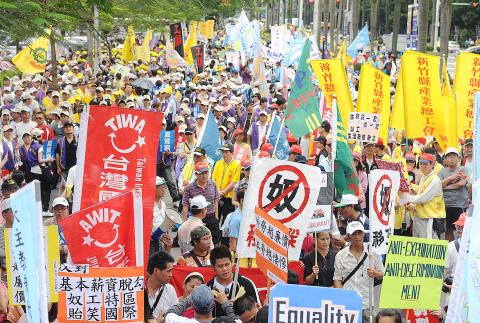
Photo: Liao Chen-huei, Taipei Times
Leading the parade, more than 200 nurses shouted: “We refuse to allow patients to take care of patients” and “patients can only be healthy when nurses get enough rest.”
Taiwan Radical Nurses Union member Liang Hsiu-mei (梁秀眉) said that in addition to protesting against insufficient manpower and rest hours, this year the union is emphasizing the serious problem of “freakish shift arrangements” — the unreasonable and frequent shift changes with only a few hours of rest in between, leading to exhaustion and sleep disorders.
Other protesters looked to future generations.
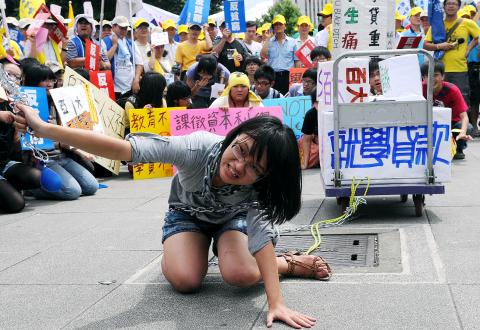
Photo: AFP
“We are standing out here not just for our generation, but also for our children. Many of our members’ children face difficulties in finding a stable job and often end up relying on their parents’ income,” said Yang Chun-hua (楊俊華), chief secretary of the Labor Union of the Taipei City Government’s Department of Environmental Protection.
Yang said about 20 percent of union members’ children were on student loans and about one-third of the members were still paying back credit card debt with their salary.
South Taiwan Passenger Transportation Ltd Liability Co Trade Union chairperson Chen Yun-hsiang (陳韻翔) said bus drivers were often forced to work excessive hours under poor health conditions, endangering the lives of passengers.
Holding signs that read “equality” and “minimum wage covers all workers,” foreign workers called for the same wage as local workers.
On Ketagalan Boulevard in the morning, hundreds of labor rights activists from about 30 civic groups held a protest against deteriorating labor conditions by performing sports competitions that symbolized exploitation or economic burdens faced by workers.
The “events” — a race to show that workers cannot catch up financially, weightlifting to represent the heavy economic burden on families and a pole-jumping competition to symbolize rising consumer and energy prices — highlighted the reality that the losers in the system are “guaranteed an unfair game,” said the Taiwan Labor Front, which organized the event.
Taiwan Labor Front secretary-general Son Yu-lian (孫友聯) said about one-fourth of salaried workers are unable to save more than NT$50,000 (US$1,714) a year and the majority barely make a living with their low wages.
A generation of breakdown and collapse is being created, Son said.
“Why is it that we workers only earn about 44 percent of the total income, but have to pay about 75 percent of the total income tax in Taiwan?” Alliance for Fair Tax Reform convener Wang Jung-chang (王榮璋) said, adding that the government was lying to the public with its promises of imposing a tax on the rich.
“The Executive Yuan recently announced it would raise the stock income tax threshold from NT$3 million, as initially proposed, to NT$4 million, but the income tax deduction for workers is only about NT$104,000,” Wang said.
Near the end of the rally, the activists pasted pieces of paper that read “poverty,” “exhaustion,” “blind,” “debt” and other characters on a large board decorated with a printout of President Ma Ying-jeou’s (馬英九) Facebook page.

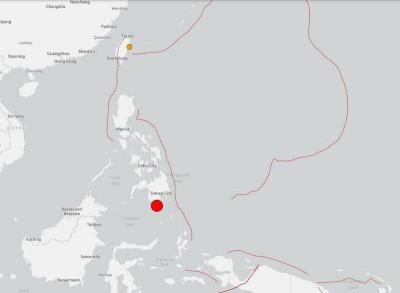
A magnitude 7.8 earthquake struck off the southern coast of Mindanao in the Philippines at 7:38am today, prompting the US Tsunami Warning System to issue an alert for neighboring countries, including Taiwan. The system issued a purple alert indicating a "tsunami threat." The potential threat zone includes Taiwan, the Philippines, Papua New Guinea, Yap and Palau. A spokesperson for Indonesia disaster mitigation agency said there were no reports of damage so far. Arlene Hollero, disaster chief of Maasim town in the Philippines' Sarangani Province, said their evacuation was underway in coastal villages and there were no reported casualties so far. DZBB radio, broadcasting from the

RESILIENCE: Taiwan plays a key role in semiconductors, energy, information infrastructure and advanced manufacturing, AIT Director Raymond Greene said Taiwan’s continued investment in deterrence and resilience remains vital, especially in uncrewed systems and other emerging technologies, American Institute in Taiwan (AIT) Director Raymond Greene said yesterday. Greene made the remarks at the annual National Strategic Summit on Supply Chain Resilience held by the Research Institute for Democracy, Society and Emerging Technology (DSET), a government-backed think tank. As Taiwan last year became the US’ fourth-largest trading partner and supply chain security is becoming more important, cooperation in emerging technologies continues to deepen between the two countries, he said. The US is committed to accelerating innovation, building key infrastructure, strengthening cooperation

The National Chungshan Institute of Science and Technology yesterday showcased its locally developed variants of the Vision 60 robotic patrol dog, which it plans to deploy on the nation’s outlying territories in the South China Sea. The variants were produced under the Joint Lab project — created by the institute and domestic companies — and assembled with domestically produced motors, lenses and artificial intelligence (AI) systems alongside licensed tech from the US, Missile and Rocket Systems Research Division deputy director Jen Kuo-kang (任國光) told the media event at a military base in Taipei’s Dazhi (大直) area. Taiwan has built up its strengths

RIGHT DIRECTION: Taiwan’s efforts to prevent forced labor include a proposal to ‘fully prohibit’ employers from withholding workers’ documents, an official said Taiwan is to establish a mechanism to restrict imports of goods linked to forced labor, the Executive Yuan said yesterday, after the US proposed imposing additional tariffs on Taiwanese goods over labor concerns. “The Ministry of Labor and the Ministry of Economic Affairs are to establish an interministerial review procedure,” Executive Yuan spokesperson Michelle Lee (李慧芝) said at a news briefing in Taipei. “The government is to use the Foreign Trade Act [貿易法] as the legal basis to restrict imports of goods produced with forced labor” and bring its supply chain governance more in line with international standards on human rights, resilience


 RSS
RSS